
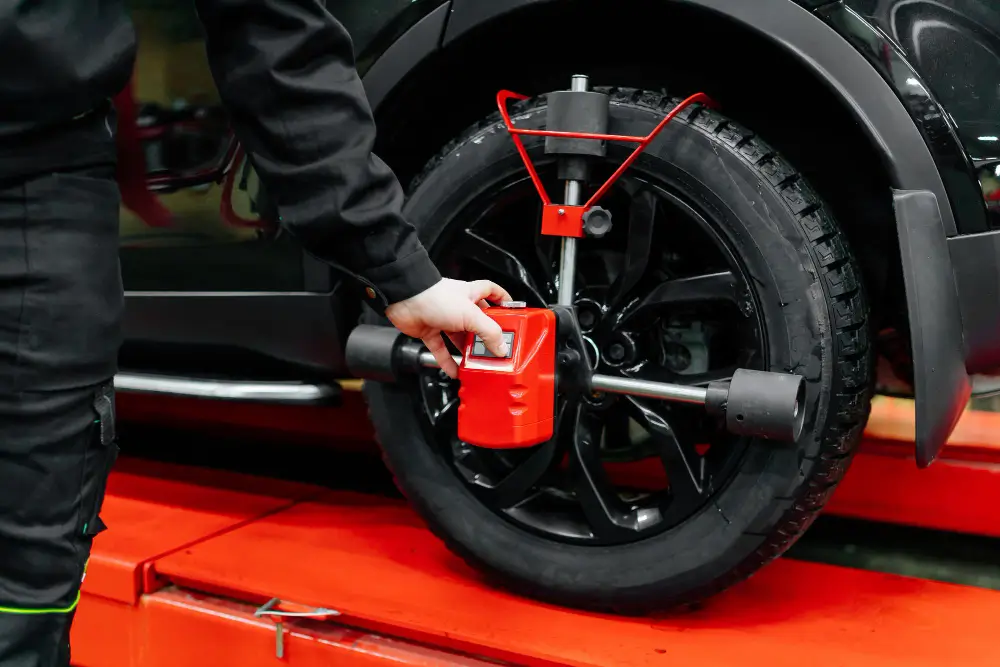
Your car does not announce this one. There is no dashboard light for it, no noise that makes you stop the car. It shows up as a steering wheel that rests a few degrees off center on Route 1, and you correct for it without noticing you are doing it. By the time you notice, you are buying tires. Knowing what bad wheel alignment feels like saves you that bill.
What Your Steering Wheel Is Telling You About Alignment
Your hands pick this up before your eyes do. Most drivers adapt to the change over weeks and stop registering it as a problem.
The Wheel Points Crooked While the Car Goes Straight
Find a flat, straight stretch with no crown and look down at your steering wheel while the car tracks straight. The logo should be level. When it rests tilted ten or fifteen degrees off center, and the car still goes where you want, the geometry underneath has shifted.
The part almost nobody explains: this often points to the rear wheels, not the front. Rear wheels have alignment angles too, and when they stop pointing straight ahead, the whole car travels at a slight angle to where it is aimed. Mechanics call it dog tracking or thrust angle. You compensate at the wheel without thinking about it. A front-wheel alignment alone will never fix this, which is why a proper four-wheel alignment measures the back of the car as well.
The Car Drifts When You Ease Your Grip
Loosen your hands on a level road and watch what happens over three or four seconds. Steady tracking is fine. A slow, consistent drift toward one lane line means something is off.
Two other steering clues get missed:
- The wheel will not return to center on its own after you come out of a turn. You have to pull it back. That points to caster.
- The steering feels vague or wandering at highway speed, and you make constant small corrections to hold a lane. That is fatigue you feel after a long drive and never connects to alignment.
Reading Tire Wear Patterns to Spot a Bad Wheel Alignment
Your tires keep a written record. Park the car, turn the wheel to full lock so you can see the inner edges, and look. Better still, run your palm flat across the tread from inside edge to outside.
Each pattern points somewhere specific:
- Sawtooth edges you feel in one direction but not the other. Smooth one way, sharp and grabby the other. This is feathering, and it comes from the toe being out of spec. Toe is the fastest tire killer of the three angles.
- One edge is worn to the wear bars, while the rest looks new. Inner or outer shoulder gone, center fine. That is camber.
- Both outer edges worn, center still good. This is underinflation, not alignment. Check your pressures.
- Center strip worn, both edges fine. Overinflation, also not alignment.
- Scalloped dips around the tread, like a wave. Cupping points to worn shocks or a long-running balance problem rather than alignment.
- One tire is wearing far faster than the other three. Something on that corner is bent or loose.
That palm test costs nothing and takes twenty seconds. Most drivers have never done it once.
Toe, Camber, and Caster: The Three Angles of a Wheel Alignment Set
Every alignment argument comes down to these three. Knowing them lets you follow what a technician tells you instead of nodding.
Toe
Look down at your car from above. Toe is whether the front of the tires point slightly toward each other or slightly away. Even a small toe error drags the tire sideways across the pavement for every mile you drive. That scrubbing is what shaves the tread into a sawtooth and burns fuel.
Camber
Look at the car head-on. Camber is the tilt of the wheel at the top, leaning in toward the car or out away from it. Wrong camber puts the load on one shoulder of the tire instead of the full tread, and that shoulder wears out while the rest of the tire looks fine. Camber that differs side to side also pulls the car.
Caster
Look at the car from the side. Caster is the tilt of the steering axis, and it controls straight-line stability and whether your wheel returns to center after a turn. Worth noting that caster on its own causes no tire wear at all. It changes how the car feels rather than how the tires look, which is why a car can feel unstable with tires that read clean.
When a Pull to One Side Is Not an Alignment Problem
Most articles on this topic tell you pulling means alignment and stop there. An honest answer is more useful because you can pay for an alignment and still have the pull.
Check these first:
- Road crown. Roads slope toward the shoulder so water runs off. A slight drift to the right on most New Jersey roads is the pavement, not your car.
- Uneven tire pressure. A few PSI between the left and right will pull the car. This costs nothing to rule out.
- Tire conicity. A tire can pull on its own from how it was built. Swap the two front tires side to side. When the pull moves to the other side, the tire is the culprit, and no alignment will cure it.
- A dragging brake caliper. This pulls harder when you brake, and the wheel on that corner runs hot after a drive.
- Worn steering and suspension parts. Loose tie rod ends, tired ball joints, or cracked control arm bushings let the geometry move around while you drive.
That last one carries the most money in it. An alignment set on worn parts will not hold because the machine measures the car at rest while the loose part shifts once you are moving. You pay for the alignment, the pull comes back in a month, and you blame the shop. Any technician worth your time inspects the shocks and suspension repair needs before touching the alignment rack, and tells you when parts have to be fixed first.
Is Your Car Out of Alignment or Out of Balance?
These two get mixed up constantly, and the confusion sends people to the wrong service.
Alignment problems show up as pulling, drifting, crooked steering, and uneven tire wear. They happen at every speed.
Balance problems show up as vibration, and the vibration is speed-sensitive. It appears somewhere around 50 to 70 mph, then fades once you go faster or slower. A shake felt through the steering wheel points to the front tires. A shake felt through your seat points to the rear.
So the rule is short. Vibration means balance. Pulling and wear mean alignment. Some cars need both, and after any pothole hit, the two often arrive together. Our guide to tire and wheel balancing breaks down that side of it.
What Knocks Wheel Alignment Out of Spec on Colonia Roads
Alignment does not drift on its own. Something moves it.
Potholes lead the list, and New Jersey supplies them. Freeze and thaw cycles crack the pavement all winter, water gets in, and by March, the roads around Woodbridge and Rahway are a minefield. AAA found that one in ten drivers took pothole damage serious enough to need a repair in a single year, at an average of nearly $600 per repair, and those drivers averaged two repairs each.
The rest of the list:
- Clipping a curb while parking, which takes less force than people expect
- Speed bumps taken at speed
- Any suspension or steering part replacement, since new parts change the geometry
- A minor collision, even a low-speed one with no visible damage
- Springs sag as the car ages, which shifts ride height and camber with it
- Lift kits and lowering springs
On timing, an annual check works for most drivers, or roughly every 10,000 to 12,000 miles. Get it checked whenever you buy new tires, after any suspension work, and after a pothole hit that made you wince.
What a Year of Driving Misaligned Costs You
This is where the shrug turns expensive.
Start with the tires. A set for a common sedan runs several hundred dollars, and toe that is out of spec scrubs the tread sideways every mile. Tires rated for 60,000 miles come off at 25,000, and you buy a second set inside the same warranty period, you should have been covered with one.
Then fuel. Tires dragging at an angle create rolling resistance the engine has to overcome, and you pay for that at every fill-up in Colonia.
Then the parts. Misaligned wheels feed load back into wheel bearings, tie rods, and bushings, and those wear faster under it. The same suspension problems that cause misalignment get worse because of it.
TRIP, a national transportation research group, puts real numbers on the New Jersey side of this. Its state fact sheet finds that driving on deteriorated roads costs New Jersey motorists $353 per driver every year in additional repairs, accelerated depreciation, extra fuel, and tire wear.
Then safety, which does not show on any invoice. Tread that wore out on one shoulder cannot channel water. Your wet braking distance stretches, and hydroplaning starts at a lower speed. On Route 27 in a September downpour, that shoulder you never inspected is what your family is riding on.
Every Mile You Drive Misaligned Is Tread You Never Get Back
Nothing about this problem gets better with time. The steering wheel stays crooked, the toe keeps dragging the tire sideways, and the tread you paid for keeps coming off in the same place, mile after mile, until the wear bars show and a set you should have kept for years lands in the scrap pile. The pull you stopped noticing months ago is the cheapest fix you will ever be offered, and it stops being cheap the day the tires go.
American Auto Repair Center runs precision wheel alignment at 1131 St. Georges Ave. in Colonia, and every alignment starts with a steering and suspension inspection so the settings hold instead of drifting back in a month. We check all four wheels, including thrust angle; we tell you when a worn part has to come first rather than aligning around it, and we quote upfront with no upselling. Our mechanics serve Colonia, Woodbridge, Edison, Rahway, Clark, Avenel, Fords, and Sewaren from our shop on St. Georges Avenue. Get in touch with us to book your alignment before your next set of tires pays the price.

