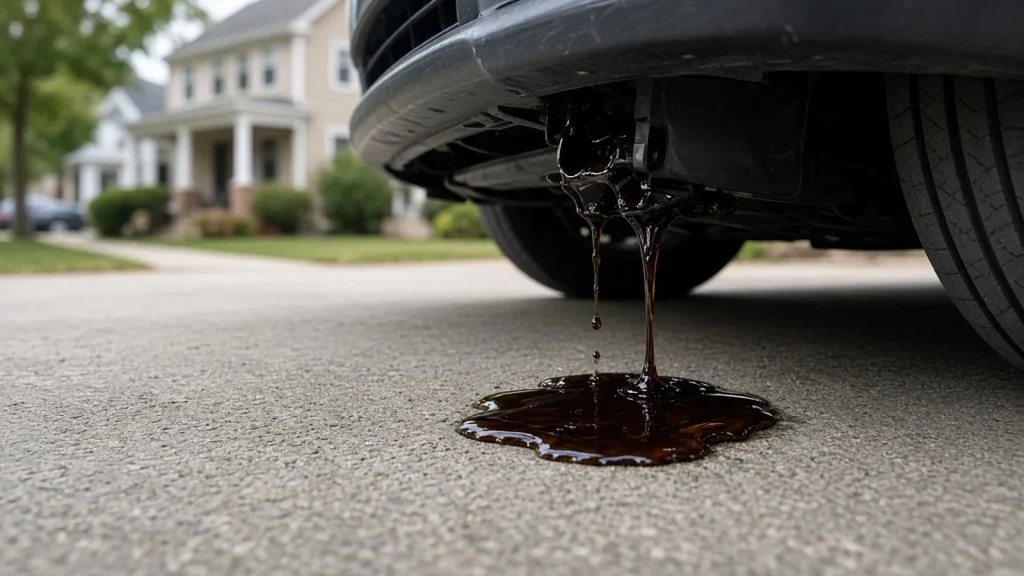
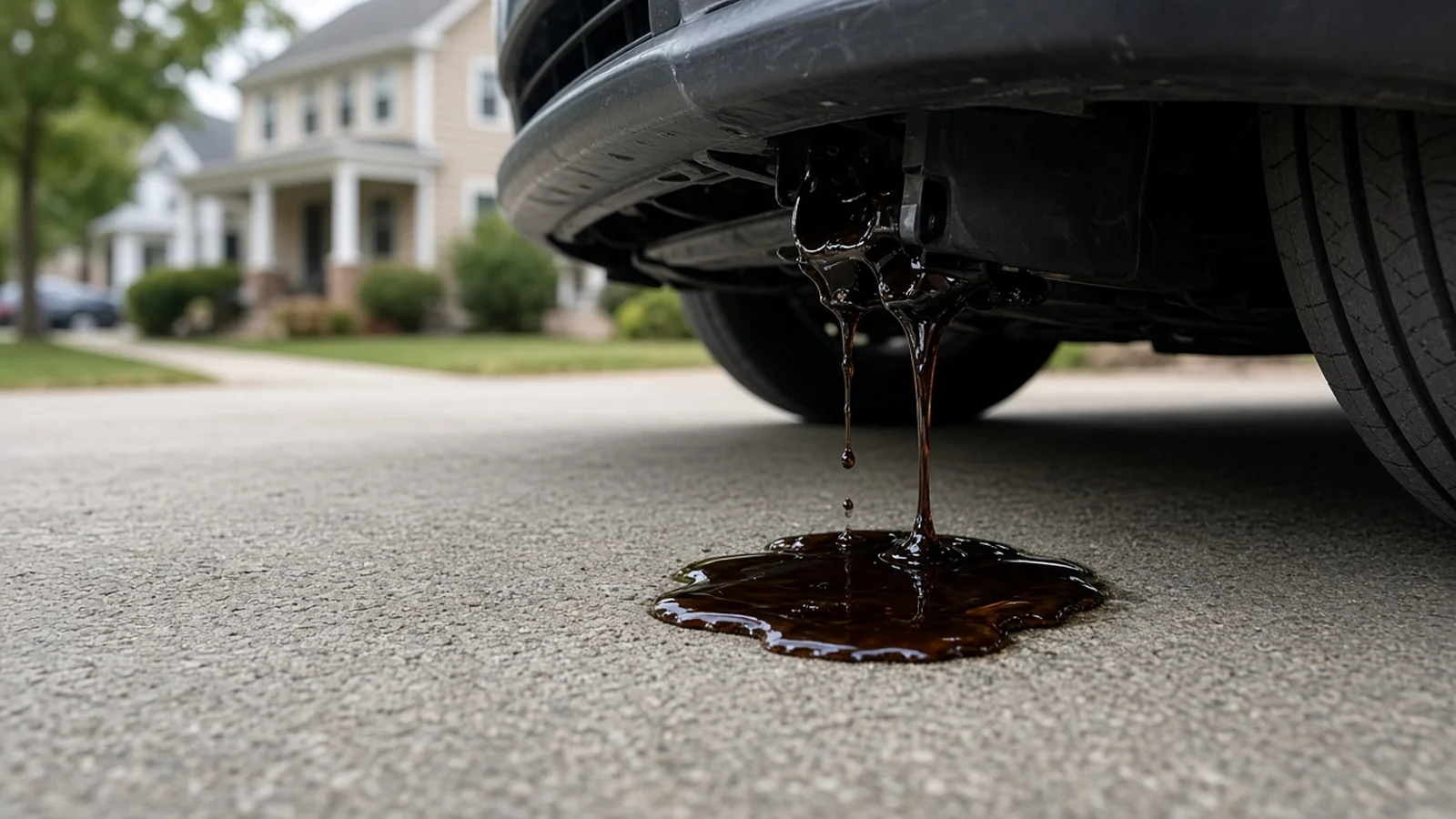
You back out of the driveway on a cold Colonia morning and there it is. A dark spot on the concrete, right where the engine sat all night. Yesterday it was not there.
A small oil spot is rarely an emergency. A spot you ignore can become one.
If your car is leaking oil in Colonia, this guide shows how to confirm it is oil, how serious the leak is, where it usually comes from, and when to stop driving. For a quick look at your level and fittings, book an
oil change in Colonia, where we check for leaks while the oil is drained.
More reading: Seeing green or orange fluid instead? Our
coolant leak guide covers that puddle.
Is that puddle really engine oil?
Before you worry about gaskets and seals, make sure the spot is oil. Engine oil has a few clear tells.
- Color: amber when fresh, brown to black when it has some miles on it.
- Feel: slick between your fingers, with almost no smell beyond a light burnt note.
- Location: under the front or middle of the car, below the engine.
Green, orange or pink fluid with a sweet smell is more likely coolant. Reddish fluid toward the middle of the car can be transmission fluid, which our
transmission slipping guide explains.
Parked in a public lot or a shared spot in Iselin? Make sure the stain came from your car before you chase it. A sheet of plain cardboard under the engine overnight settles the question.
How serious is the leak? Seep, drip or puddle
Not every leak needs the same urgency. How much oil you see, and how fast it comes back, tells you how soon to act.
| What you see |
What it usually means |
What to do |
| Damp, oily film on the engine but no drops on the ground |
A seep from an aging gasket |
Watch the oil level and mention it at your next service |
| A few drops on the cardboard overnight |
An active drip |
Check the level and book an inspection soon |
| A spot that grows every day, or a fresh puddle after short trips |
A steady leak |
Book now and check the dipstick before each drive |
| Oil running while parked, or a trail on the road |
A large leak |
Do not drive far. Call us first |
| Oil light, smoke or a strong burning smell |
Low oil or oil on hot parts |
Stop driving. See the stop signs below |
A seep is common on older engines and may sit unchanged for months. The level is what matters most. As long as it holds steady between checks, you have time to plan.
Check your oil level first, the safe way
The dipstick tells you more than the driveway does. A big stain with a full dipstick is a mess. A small stain with a low dipstick is a problem.
- Park on level ground and shut the engine off.
- Wait until the engine has cooled. Hot oil and hot metal burn.
- Pull the dipstick, wipe it clean and push it all the way back in.
- Pull it again and read where the oil sits between the two marks.
- If it is low, top up with the oil grade listed in your owner’s manual, a little at a time.
- Recheck after each small pour. Never fill above the full mark.
Some newer cars have no dipstick and show the oil level on the dash display instead. Your owner’s manual explains how to read it. If you are unsure, our
oil change service starts with a dipstick and leak check under the vehicle.
Where oil leaks usually come from
Your engine has dozens of gaskets and seals. Rubber and cork harden as they age and heat up, then cool down again thousands of times. Cold winter mornings tend to show the tired ones. These are the usual suspects, from the simplest to the hardest to reach.
Oil filter and drain plug
These two cause many leaks right after an oil change. A filter can be loose, cross-threaded, or installed over the old filter’s rubber gasket, leaving two stacked gaskets that never seal.
At the drain plug, an old crush washer can let oil weep at the threads. We install a new crush washer on the drain plug at every oil change for exactly that reason.
Valve cover gasket
The valve cover sits on top of the engine. When its gasket hardens, oil seeps out and runs down the sides.
If it lands on the exhaust, you may smell burning oil. On some engines it can also pool in the spark plug wells and cause a rough run. Our
burning smell guide covers what that odor can mean.
Oil pan and its gasket
The oil pan is the bowl at the bottom of the engine that holds the oil. Its gasket can shrink or crack with age.
The pan itself sits low, so a pothole or road debris on Route 1 or the Parkway can dent or crack it. Leaks here tend to drip straight down under the engine.
Crankshaft and camshaft seals
These round seals sit where spinning shafts leave the engine. A front seal leak often gets flung around by the pulleys, leaving oil sprayed across the front of the engine. Seal leaks near the timing cover are often checked during
timing belt service, since the area is already open.
Rear main seal
This seal sits where the engine meets the transmission. A leak here shows up as a drip toward the middle of the car, between the engine and transmission. It is harder to reach, so it needs a proper lift inspection to confirm before anyone recommends a repair.
Oil cooler lines and hoses
Many cars, trucks and turbo engines route oil through cooler lines or hoses. Corroded fittings or worn hoses can leak, and the spot may show up farther from the engine than you expect.
Filler cap, overfill and spills
Rule out the simple causes first. A loose, cracked or missing filler cap lets oil escape. Too much oil raises pressure and can push oil past seals. And oil spilled during a top-up can drip for a day or two, looking just like a leak.
Why the drip you see is rarely the source
Oil flows downhill. While you drive, air also blows it back across the engine and underbody. So the wettest spot is usually where the oil collects, not where it starts.
That is why a shop traces oil to the highest wet point. Sometimes the area gets cleaned, the car is driven, and the spot is checked again to see where fresh oil appears. For hard cases, a fluorescent dye in the oil glows under a UV light right at the leak.
Please skip the DIY version. Spraying degreaser around a running engine, or crawling under a car held up only by a jack, is a real safety risk. One more surprise: switching from conventional to synthetic oil does not cause leaks, but it can reveal a seal that was already worn.
Leaking oil right after an oil change
A fresh spot a day or two after service is frustrating. Most of the time, the cause is simple and quick to correct.
- A filter that is loose or has a doubled gasket
- A drain plug without a fresh washer, or one that was not tightened right
- A filler cap left loose
- Oil filled above the full mark
- Oil spilled on the engine during the fill
Bring the car back soon so the level and fittings can be checked. At our shop, the last step of every oil change is Verify: we run the engine, recheck the level, and confirm there are no drips before the car leaves the bay.
Oil leak plus a burning smell or blue smoke
Here two different problems can look alike. If you smell burning oil inside the car, it could mean oil is leaking onto hot exhaust components. You may see light smoke from under the hood after a drive.
Blue or gray smoke from the tailpipe is different. It usually indicates oil burning inside the engine, not a leak outside it. Either way, it is worth booking an inspection rather than waiting it out.
What a small oil leak can turn into
Oil is the only thing keeping metal parts from grinding against each other. A slow leak takes a little of that protection away every day.
- Low oil: parts run hotter and wear faster when the level drops.
- Damaged rubber: oil softens belts and hoses it drips onto, so they can fail early.
- Smoke and smell: oil on the exhaust smokes and smells every time you drive.
- A bigger leak: a gasket that seeps today can let go further later.
- Stains and slip spots: oil marks driveways and garage floors. Kitty litter soaks up fresh spots.
Regular
preventive maintenance catches most seeps long before they reach this stage, because someone is looking under the car on a schedule.
When to stop driving
Most leaks give you time. These signs do not.
- The red oil pressure light or oil can symbol comes on
- The dipstick reads below the add mark
- Smoke rises from under the hood
- A strong burning oil smell fills the cabin
- New knocking or ticking from the engine
- A puddle that grows fast while the car sits
If the oil change light stays on after you start the engine, it usually indicates low oil pressure or a lubrication issue. Pull over safely and shut the engine off. Do not keep topping up and driving. Call us first, and our
engine diagnostic team can read warning lights before anything else gets damaged.
Can you wait on a small leak?
Plenty of drivers from Rahway and Avenel ask us this. It is a fair question. A light seep with a steady level can often wait until your next service, as long as you keep checking the dipstick.
What we do not recommend is a bottle of stop-leak additive. It cannot fix a loose filter, a dented pan or a failed seal, and the leak usually comes back. Worried about an upsell? Every repair here starts with a written estimate. You decide what gets fixed and when.
How we fix an oil leak at American Auto Repair Center
For 25 years, Colonia drivers have trusted our shop at 1131 St. Georges Ave. with problems like this one. An oil leak gets the same four steps as every repair.
- Inspect. We check the oil level and condition, put the car on a lift, look for wet areas, and trace the oil to its highest wet point. When needed, we clean and recheck or use dye.
- Quote. We explain what we found in plain words and give you a written estimate before any work starts.
- Repair. We fix only what the inspection shows. That may be a filter, a drain plug washer, a gasket, a seal, a line or the oil pan.
- Confirm. We run the engine, recheck the level and confirm there are no drips.
Bring a photo of the spot or your cardboard sheet. Where the oil landed helps us start in the right place.
Related reading and how to reach us
A spot on the driveway is easier to fix now than later. Call
(732) 702-3999 or visit American Auto Repair Center at 1131 St. Georges Ave., Colonia, NJ 07067. We are open Monday to Friday 8:30 AM to 6:00 PM and Saturday 8:30 AM to 4:00 PM, closed Sunday.
Oil leak FAQs
Why is my car leaking oil?
Most oil leaks come from a loose or damaged oil filter, a drain plug washer, a worn valve cover or oil pan gasket, or a tired crankshaft or camshaft seal. Rubber gaskets and seals harden with age and heat. A shop traces the oil to its highest wet point to find the real source.
Is it safe to drive with an oil leak?
A light seep with a normal oil level is usually safe to drive while you book an inspection. Stop driving if the oil pressure light comes on, the dipstick reads below the add mark, you see smoke, or the puddle grows quickly.
How do I know if the spot under my car is oil?
Engine oil is usually brown to black and feels slick, and it tends to drip under the front or middle of the engine. Green, orange or pink fluid with a sweet smell is more likely coolant.
Why is my car leaking oil after an oil change?
The usual causes are a filter that is loose or has a doubled gasket, a drain plug without a fresh washer, a loose filler cap, overfilled oil, or oil spilled during the fill. Bring the car back soon so the level and fittings can be checked.
Can an oil leak cause a burning smell?
Yes. If oil leaks onto hot exhaust components, it can smell like burning oil and may smoke. Blue or gray smoke from the tailpipe usually indicates oil burning inside the engine instead.
What does the oil pressure light mean?
If the oil light stays on after you start the engine, it usually indicates low oil pressure or a lubrication issue. Pull over safely, shut the engine off, check the oil level once the engine has cooled, and call a shop before driving further.
Should I use an oil stop-leak additive?
We do not recommend relying on one. It does not fix a loose filter, a damaged pan or a failed seal, and the leak usually returns. Finding the source is the reliable fix.
How does American Auto Repair Center find an oil leak?
We check the oil level and condition, inspect the engine on a lift, and trace the oil to its highest wet point, cleaning and rechecking when needed. Then we explain what we found and give a written estimate before any work starts.