You pull into a tight parking spot or swing a U-turn on St. Georges Ave, and the front of the car answers with a click-click-click. It stops when you straighten the wheel. Then it comes back on the next sharp turn.
That sound is not just the road. A repeating click during turns is your car telling you something in the front end is worn, loose, or working harder than it should. The good news is that the pattern of the click narrows the list a lot before anyone lifts the car.
This guide is for Colonia, Clark, Avenel, and Woodbridge Township drivers who want a clear answer. You will learn which turn-click patterns point to a CV axle, which point to suspension or steering parts, which point to brakes or a wheel bearing, what is safe to check yourself, and what a shop actually inspects on the lift.
If the click comes with clunks, bounce, or a loose feel, start with shocks and suspension repair in Colonia. If you are not sure where the noise is coming from, engine diagnostic and electrical service is the wider inspection path. American Auto Repair Center is at 1131 St. Georges Ave, Colonia, NJ 07067. Call (732) 702-3999 during shop hours.
More reading: Why is my car making a clicking noise? · Dead battery in Colonia? Won’t start checklist
Is a turn click urgent?
Most turn clicks give you some warning time. A few signs mean the car should be looked at before your next run on the Parkway or the Turnpike.
Book soon
- A quiet click only on sharp, slow turns, like parking or U-turns
- The sound has not changed much over a week or two
- No vibration, no pull, and steering feels normal
- No grease on the inside of the wheels
Get it checked before highway driving
- A loud, fast click on every turn, even gentle ones
- Vibration that grows when you accelerate
- Dark grease sprayed around the inside of a front wheel
- Grinding, a clunk that you feel through the floor, or steering that feels loose
- The car started pulling or wandering after a pothole or curb hit
Until it is inspected, take turns gently and avoid hard acceleration while the wheel is turned. That is when a worn CV joint is under the most load.
What you hear and what to check first
Use this table as a starting filter, not a parts order. Patterns overlap, and one visit often checks the axle, the suspension, and the brakes together.
| What you notice | Often points to | First check |
|---|---|---|
| Fast click-click-click while accelerating through a tight turn | Worn outer CV joint, often with a torn boot | CV boots and axle joints on both sides |
| Single pop or click when you first turn the wheel, even nearly stopped | Strut mount, ball joint, bushing, or a steering part | Suspension and steering joints on the lift |
| Click or clunk over bumps while turning into a driveway | Sway bar links or other suspension hardware | Links, bushings, and mounts |
| Tick or scrape that changes with wheel speed | Bent dust shield, debris, an object in the tire, or brake hardware | Wheel area and brake parts |
| Hum or growl that rises with speed more than with turning | Wheel bearing or tire wear | Bearing play and tire condition |
| Rapid clicking only when you turn the key | Battery, starter, or cables, not a turning problem | Starting and charging test |
If your click is the last row, this is the wrong guide. The dead battery and won’t start checklist covers startup clicking.
CV joints in plain English
Front-wheel-drive and all-wheel-drive cars send power to the front wheels through axles called CV axles. Each one has a joint at both ends that lets the wheel turn and move up and down while it is still being driven.
The outer joint, near the wheel, works hardest on sharp turns because it bends the most. That is why a worn one usually clicks in parking lots and on U-turns rather than on straight roads.
Why the boot matters
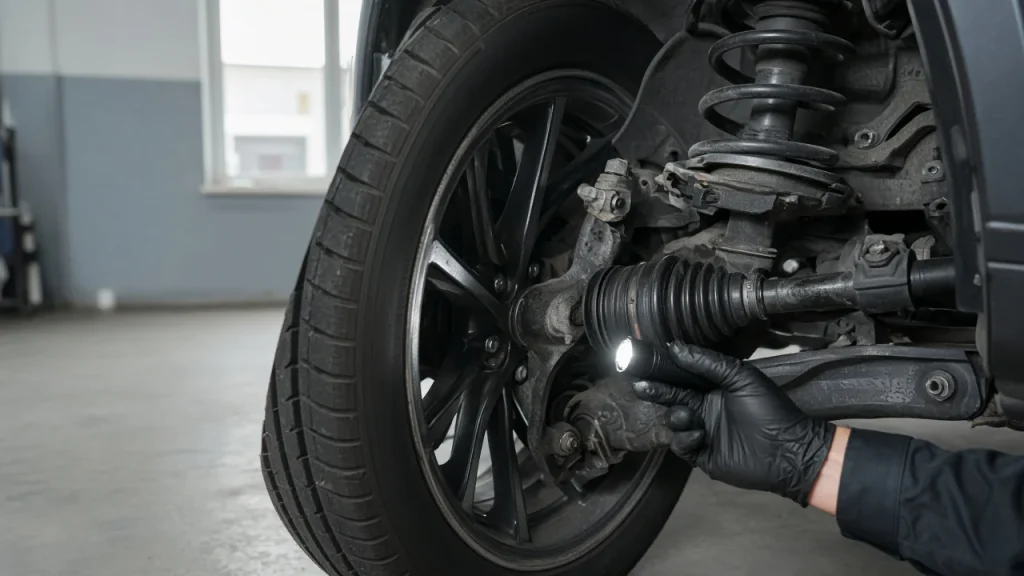
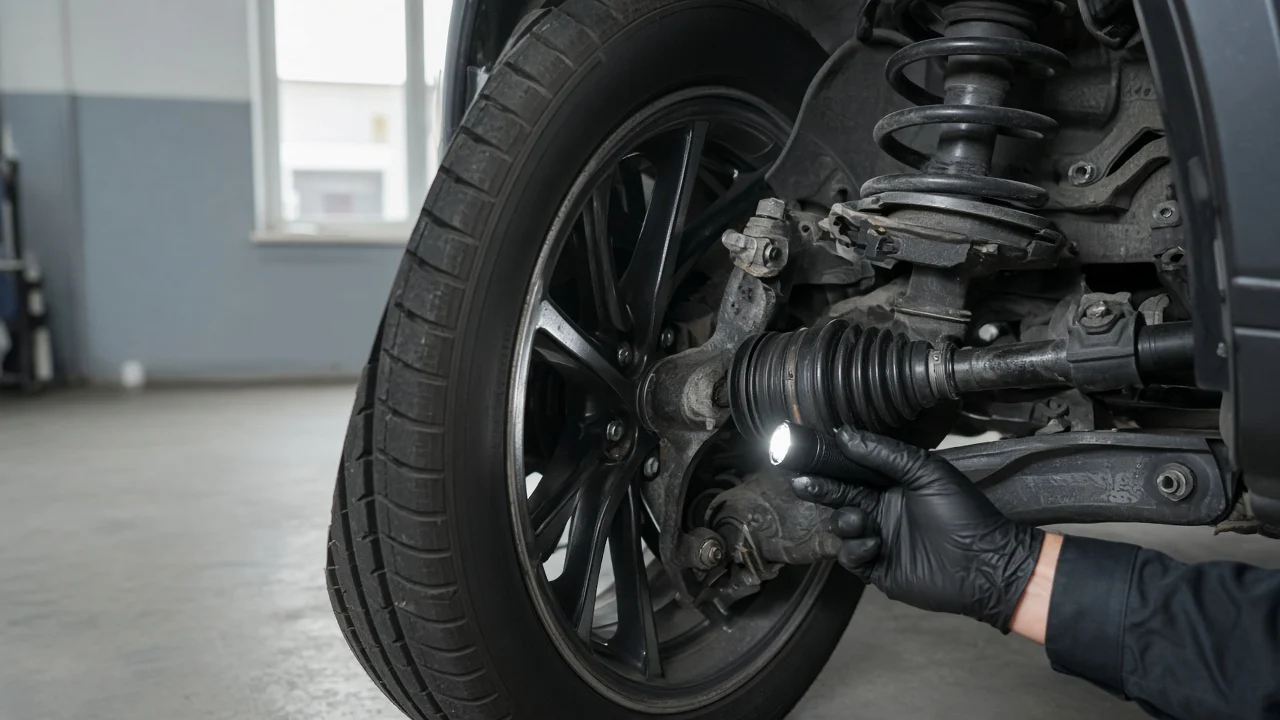
Each joint is packed with grease and covered by a ribbed rubber boot. The boot keeps grease in and dirt and water out. Over time the rubber can crack from age, heat, road salt, or a hit from debris.
- The boot tears.
- Grease spins out and lands on the inside of the wheel or nearby parts.
- Grit and water get into the joint.
- The joint wears and starts to click under load, first on tight turns, then more often.
Catching a torn boot early can sometimes limit the damage. Once the joint is clicking, the shop checks whether it is already worn enough to need replacement. The noise alone cannot tell you that.
What you can safely look at
With the car parked, engine off, and the wheel turned all the way to one side, use a flashlight to look behind the front tire. You are looking for a split in the rubber boot or dark grease thrown around the area. That is as far as a driveway check should go. Axle work needs a lift and the right tools.
When it is not the axle
Plenty of turn noises have nothing to do with the CV joints. Here is how the other common causes usually show up.
Suspension and steering joints
Ball joints, tie rod ends, strut mounts, and control arm bushings hold the wheel in place while it steers. When they wear, you often hear a single pop or creak as you start turning, or a clunk over bumps. The car may feel loose or wander. Our guide to shocks, struts, and suspension in Colonia covers bounce and clunk symptoms in more detail.
Brake hardware
Loose pad clips, a worn caliper slide, or a bent dust shield can tick or scrape, and the sound may change when you lightly press the brake. If braking feels different too, see brake repair in Colonia and our brake squeaks and soft pedal guide.
Wheel bearings
A worn wheel bearing usually hums or growls rather than clicks. The noise grows with speed and may get louder or quieter as you lean the car into a turn. It is a different sound from the sharp click of a CV joint, but both live near the wheel, so the shop checks both.
Wheels and tires
A stone in the tread, a nail, or a loose wheel cover can tick with every rotation. After a recent tire rotation or new tires, lug nuts that were not tightened properly can also click. That one is worth checking quickly. Wheels and tires service covers it.
Power steering
Low power steering fluid usually makes a whine or groan when you turn the wheel, often loudest at low speed. It is still worth checking the fluid level and looking for leaks. A classic click-click-click from the wheel area, though, usually leads back to the CV joints or the suspension.
No single sound always means the CV axle. That is why an inspection comes before a quote.
Notes to take before you call
A few minutes of careful listening helps the shop reproduce the noise faster. Write down what you notice.
- Does it click turning left, right, or both?
- Is it louder when you accelerate through the turn?
- Does it happen only on sharp turns, or on gentle curves too?
- Do you also hear a clunk over bumps?
- Does the sound change when you touch the brake?
- Did it start after a pothole, a curb hit, new tires, or a rotation?
- Have you seen grease on the inside of a front wheel?
Safe to do yourself
- Listen with the radio off while making slow circles in an empty lot
- Look behind the front wheels for a torn boot or grease
- Ask the tire shop to confirm the lug nuts were tightened after recent tire work
Leave to the shop
- Checking for play in joints, ball joints, and tie rods
- Inspecting brake hardware and bearings with the wheel off
- Road testing in both directions under load
- Any axle, joint, or suspension replacement
Common turn-click scenarios in Colonia
These are the situations drivers around Colonia most often describe. Your own car may fit one of them.
| Situation | What it often suggests | What to do |
|---|---|---|
| Clicks only when backing out of the driveway or a parking spot at full lock | Early outer CV joint wear | Book an inspection soon and look for boot damage |
| Started clicking right after a pothole or curb hit | Bent or damaged suspension part, wheel, or dust shield | Inspection plus an alignment check |
| Clicks after new tires or a rotation | Lug nuts, wheel cover, or debris | Have the wheels rechecked first |
| Click plus vibration when accelerating | CV joint wear that has progressed | Get it checked before highway driving |
| Creak or pop when turning in cold weather | Dry bushings, strut mounts, or ball joints | Suspension inspection |
What happens at American Auto Repair Center
Our goal is to find the actual source of the noise before we recommend a part. Here is how a visit for a turn click usually goes.
- Road test. We drive the car through tight turns in both directions to reproduce the sound you hear.
- Lift inspection. We check CV boots and joints, ball joints, tie rods, strut mounts, bushings, sway bar links, brake hardware, wheel bearings, and the wheels and tires.
- Explain and quote. We show you what we found in plain language and give you a quote before any work begins.
- Repair. We fix only what you approve.
- Alignment check if needed. When suspension or steering parts are replaced, the angles can change, so we check wheel alignment.
- Confirm. A short road test makes sure the click is gone.
American Auto Repair Center is at 1131 St. Georges Ave, Colonia, NJ 07067, an easy drive from Clark, Avenel, Rahway, and Edison. Hours are Monday to Friday 8:30 AM to 6:00 PM and Saturday 8:30 AM to 4:00 PM, closed Sunday.
Related problems that feel like a click
Some noises get mixed up with a turn click. If one of these sounds closer to what you hear, this reading may help.
- Clicking when you turn the key: dead battery and won’t start checklist
- Bounce, nose dive, or clunk over bumps: shocks and struts guide
- Steering wheel shake at highway speed: steering wheel shakes on the highway and wheel balancing
- Squeal, soft pedal, or vibration when stopping: brake squeaks and soft pedal guide
- Tires wearing on one edge after suspension play: uneven tire wear guide
- Clicks at startup, over bumps, and while braking: why is my car making a clicking noise?
- Staying ahead of worn parts: preventive maintenance schedule and preventive maintenance service
- Every service in one place: Colonia auto repair services guide
Get the click checked
A turn click rarely fixes itself, and it usually gets louder over time. When you hear it on more turns or feel vibration with it, it is time for a look.
Book a suspension inspection or an engine and electrical diagnostic at American Auto Repair Center. If the noise changes when you brake, mention it so we check the brakes too. Call (732) 702-3999, or stop by 1131 St. Georges Ave, Colonia during shop hours.
Frequently asked questions
Why does my car make a clicking noise when turning in Colonia?
A repeating click on tight turns often points to a worn outer CV joint, especially on front-wheel-drive and all-wheel-drive cars. Suspension joints, brake hardware, a wheel bearing, or something loose near the wheel can sound similar, so a lift inspection confirms the cause before any part is ordered.
Is clicking when turning always a bad CV axle?
No. A fast click-click-click while you accelerate through a sharp turn makes the CV joint a top suspect. A single pop when you first turn the wheel, a click over bumps, or a tick that changes when you touch the brake can point somewhere else. Do not buy an axle based on the sound alone.
What does a torn CV boot look like?
It is the ribbed rubber cover on the axle, just behind the front wheel. A torn boot looks cracked or split, and you may see dark grease thrown on the inside of the wheel or nearby suspension parts. Catching a torn boot early can limit damage to the joint, and the shop confirms whether the joint is already worn.
Is it safe to keep driving with a clicking CV joint?
A mild click with no vibration, no grease spray, and no change in how the car pulls usually allows a gentle, short drive to the shop. A loud or worsening click should not be ignored. A joint that fails completely can stop power from reaching that wheel.
Why is the click louder turning left or right?
Turning shifts the car’s weight to one side, which loads one set of joints harder than the other. A worn part often clicks more in one direction. Sound also travels, so the shop road tests both directions and inspects both sides.
Can low power steering fluid cause clicking when I turn?
Low fluid more often causes a whine or groan while you turn the wheel than a sharp click from the wheel area. It is still worth checking the fluid and looking for leaks, but a classic parking lot click-click-click usually leads to the CV joints or suspension.
How is this different from a clicking noise when I start the car?
Rapid clicking when you turn the key usually points to the battery, starter, or cable connections. Clicking while the car is moving through a turn is a drivetrain, suspension, or wheel-area question. They need different checks.
When can I bring my car to American Auto Repair Center?
The shop is at 1131 St. Georges Ave, Colonia, NJ 07067. Hours are Monday to Friday 8:30 AM to 6:00 PM and Saturday 8:30 AM to 4:00 PM, closed Sunday. Call (732) 702-3999 to set up an inspection.