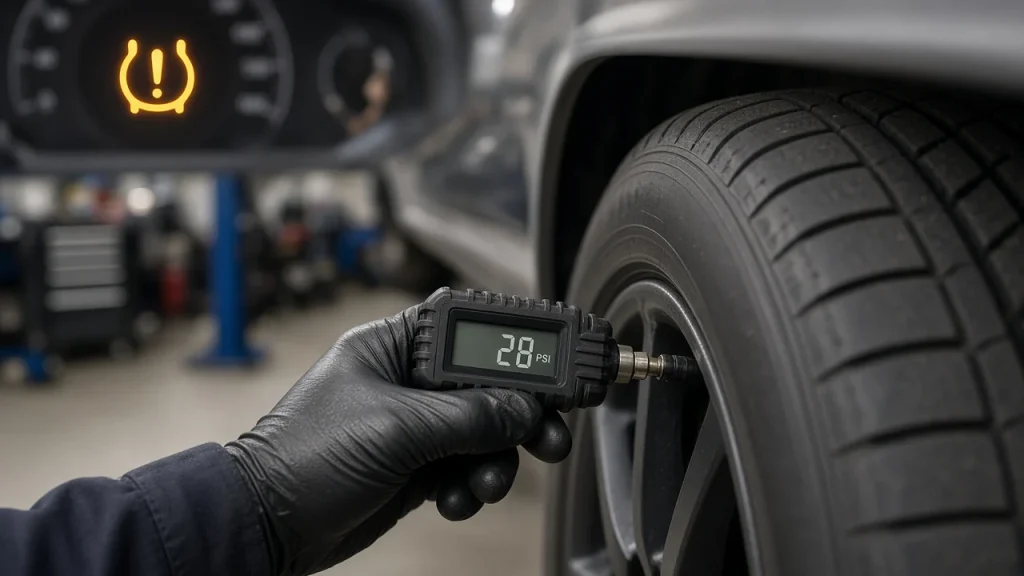
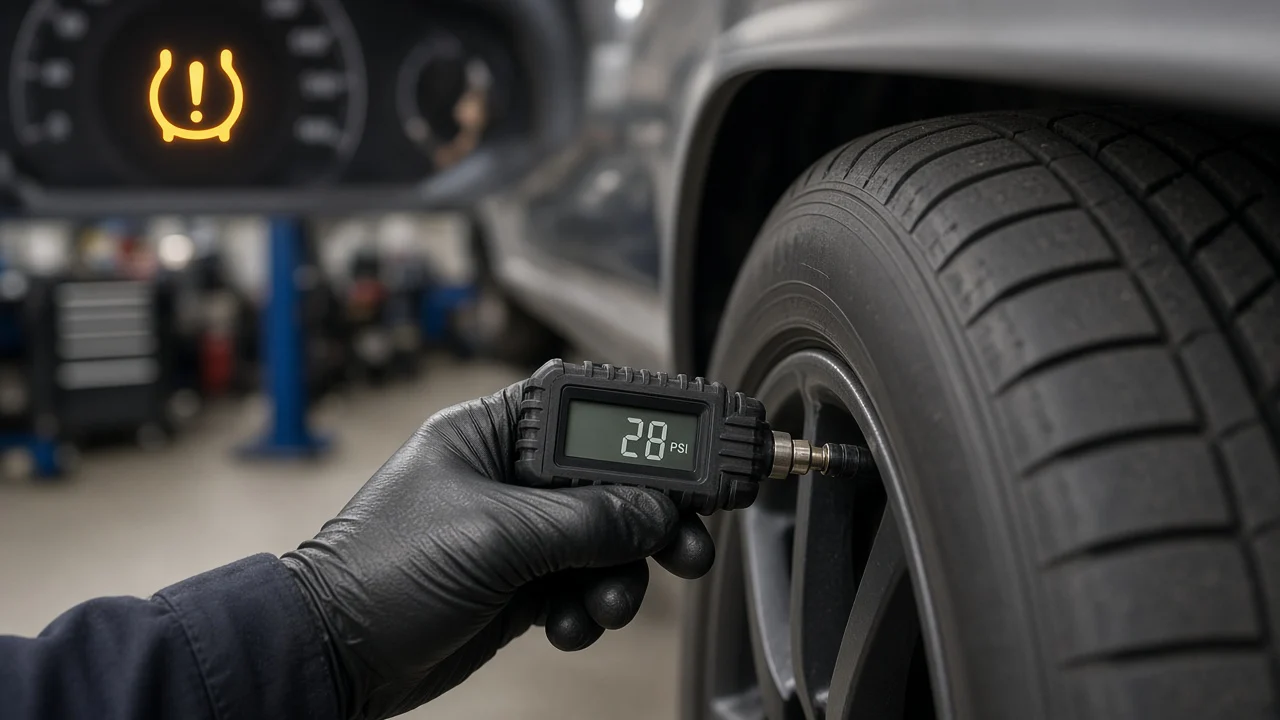
It is a cold October morning in Colonia. You start the car, back out of the driveway, and a little yellow light pops up on the dash. It looks like a horseshoe with an exclamation point in the middle.
That is your tire pressure light. Sometimes it means one tire is a little low after a chilly night. Sometimes it means a nail picked up on St. Georges Ave is slowly letting air out. And sometimes the tire is already flat by the time you walk out to the car.
This guide is for drivers in Colonia, Woodbridge, Clark, Iselin, Avenel, and Rahway who want a straight answer. You will learn what a solid light and a flashing light mean, when it is safe to keep driving, how to check and fill your tires the right way, what causes slow leaks, and how a shop decides between a repair and a new tire.
If you already know you need help, start with our wheel and tire service in Colonia. American Auto Repair Center is at 1131 St. Georges Ave, Colonia, NJ 07067. Call (732) 702-3999 during shop hours.
More reading: If your tires are wearing down unevenly rather than losing air, see our uneven tire wear guide for Colonia.
Solid, flashing, or flat? Quick triage
The light can tell you three different things. Sort out which one you have before you decide what to do next.
Solid light
One or more tires is low. Most systems warn when a tire drops roughly 25% or more below the pressure on your door sticker, per industry guidance. Check all four tires soon, the same day if you can.
Flashing, then solid
If the light blinks for about a minute after you start the car and then stays on, the monitoring system itself has a problem. A sensor may be damaged or have a weak battery, or the system may not have been set up after a tire swap. Your tires may be fine, but the car can no longer warn you. Get it checked.
Flat or thumping
The tire looks low or pancaked, the car pulls, or you hear a flapping or thumping sound. This is past the warning stage. Do not keep driving on it.
Some cars show which tire is low on the dash. Others only turn on the light and leave you to find the tire. Either way, a tire gauge tells you more than the light does.
Is it safe to drive? Go-slow vs stop clues
A low tire and a flat tire are not the same problem. Use these clues to decide how far you can go.
Usually OK to drive gently to air or the shop
- The light is solid, not flashing
- All four tires look normal when you walk around the car
- The car tracks straight and the steering feels normal
- No new noise, vibration, or smell
Pull over and stop
- A tire is visibly flat or sagging
- You see a bulge or bubble on the side of the tire
- The steering pulls hard to one side
- You hear thumping or flapping that changes with speed
- You smell hot rubber
- The light came on right after a loud bang from a pothole or curb
If you need to stop, get fully off the road before you do anything. Never change a tire in a traffic lane. Put on the spare only where you are safe, or call for help.
Driving on a flat does more than wear the tread. It crushes the tire from the inside and can bend the rim. A puncture that could have been patched often becomes a tire that has to be replaced. If the car pulled after a hard pothole hit, ask for an alignment check in Colonia once the tire is sorted.
Why the light comes on during cold Colonia mornings
A lot of drivers see the light for the first time each year in fall. That is not a coincidence.
Cold air takes up less space than warm air. When the overnight temperature drops, the air inside your tires drops in pressure too. A tire that was a little low in September can cross the warning line on the first cold morning in October.
Here is the catch. The light may go off after a few miles as the tires warm up. That does not mean the problem fixed itself. The tire is still low, and the light will likely come back the next cold morning.
Cold weather is not the only cause. Local roads add their own wear and tear:
- Potholes on Route 1, Route 27, and side streets after a hard winter
- Curb hits while parking or turning tight corners
- Nails and screws near construction or home projects
- Road salt that corrodes the rim where the tire seals
How to check and fill your tires the right way
You do not need special tools. A simple tire gauge and an air pump at a gas station are enough.
- Check when the tires are cold. First thing in the morning, or after the car has sat for a few hours. Driving warms the tires and gives a higher reading.
- Find the right number. Use the pressure listed on the sticker inside the driver’s door jamb or in the owner’s manual. Do not use the number printed on the tire sidewall. That is the tire’s maximum, not what your car needs.
- Check all four tires. Some cars also monitor the spare. If yours does, check it too.
- Fill and recheck. Add air in short bursts, then check again with your gauge. Gas station gauges are not always accurate.
- Drive a short distance. Many systems turn the light off on their own after a few minutes of driving. Some cars need a reset.
If the light comes back within a few days, you most likely have a slow leak. Topping off again buys time, but it does not find the cause.
Slow leak clues: where the air goes
A tire that keeps losing air almost always has a reason. These are the common ones.
Nail or screw
The most common cause. A nail can sit in the tread for weeks and leak a little at a time. Look for a shiny metal head in the tread.
Valve stem
The small rubber or metal stem where you add air can crack or loosen with age. Valve stems wear out over time, even when the tire looks fine.
Bead or rim
The bead is where the tire seals against the wheel. Corrosion, dirt, or a bent rim edge can let air seep out slowly. Road salt makes this more common on older wheels.
Pothole damage
A hard hit can bend the rim, cut the tire from the inside, or cause a bulge. Damage like this often cannot be repaired.
Old or cracked tire
Rubber dries out and cracks with age. Small cracks on the sidewall can leak and are a sign the tire is near the end of its life.
If you want a clue before you come in, spray a little soapy water on the tread, the valve stem, and where the tire meets the rim. Bubbles show where air is escaping. Treat it as a hint, not a diagnosis.
Repair or replace? How the decision is made
Not every flat means a new tire. Not every flat can be fixed either. The answer depends on where the damage is, how big it is, and whether the tire was driven flat.
| Usually repairable | Usually needs a new tire |
|---|---|
| A clean puncture in the main tread area | Damage to the sidewall or the shoulder, where the tread meets the side |
| A hole no larger than about 1/4 inch, per industry guidance | Larger holes, cuts, or tears |
| A tire that was not driven while flat | A tire driven flat with damage inside |
| No earlier repair close to the new hole | A repair that would overlap an old one |
| Tread depth still above 2/32 inch | Tread worn to 2/32 inch, a bulge, sidewall cracks, or a tire about six years old or more |
Run-flat tires and some performance tires have their own limits set by the tire maker. We follow those limits.
The only way to know for sure is to take the tire off the wheel and look inside. Damage you cannot see from the outside is often what decides it.
Plug vs patch: why a roadside plug is temporary
A plug kit from the auto parts store pushes a sticky cord into the hole from the outside. It can get you to a shop. It is not meant to be the final fix.
Industry guidance on proper tire repair is clear on a few points:
- The tire comes off the wheel so the inside can be inspected
- The hole is filled and sealed from the inside with a plug and patch together
- A plug alone or a patch alone is not a proper repair
- Repairs are made in the tread area only, never the sidewall
That is how we repair punctures at American Auto Repair Center. If you already used a roadside plug, that is fine. Drive gently, keep an eye on the pressure, and bring it in so the repair can be done properly from the inside.
We also skip tire sealant in a can unless it is your only way off the road. It can make the inside of the tire messy and can interfere with the pressure sensor.
What happens at American Auto Repair Center
Our process follows Inspect, Quote, Repair, Confirm. The goal is to find the real reason the tire lost air, not just fill it up and send you off.
- Inspect. We check all four tires and find the leak, whether it is in the tread, the valve stem, the bead, or the rim. We also scan the pressure sensors to see whether the system is reading correctly.
- Quote. We explain in plain language whether the tire can be repaired or should be replaced, and we give you a quote before any work starts.
- Repair. We do the work you approve: a plug and patch from the inside, valve stem or sensor service, or tire replacement.
- Confirm. We set every tire to the correct pressure, reset or calibrate the monitoring system if needed, and make sure the light is off before you leave.
When a tire comes off and goes back on the wheel, it should be balanced. Learn more about our wheel balancing in Colonia. If the car pulled after a pothole, an alignment check is worth adding to the same visit.
American Auto Repair Center is at 1131 St. Georges Ave, Colonia, NJ 07067, a short drive from Clark, Iselin, Avenel, Woodbridge, and Rahway. Hours are Monday to Friday 8:30 AM to 6:00 PM and Saturday 8:30 AM to 4:00 PM, closed Sunday. Call (732) 702-3999 to set up a tire and pressure sensor check.
Keep the light from coming back
Most tire pressure problems are easier to prevent than to fix. A few simple habits help.
- Check the pressure in all four tires once a month with your own gauge
- Check again when the weather turns cold in the fall
- Rotate your tires on the schedule in your owner’s manual
- Ask for a quick tire and valve stem look at every oil change or routine visit
- Replace old or cracked tires before they start leaking
For a full plan of checks through the year, see our preventive maintenance schedule and our preventive maintenance service in Colonia.
Related problems and next steps
Tire pressure issues often sit next to a few other problems. If one of these sounds closer to what you are dealing with, follow that path.
- Tires wearing on the inside edge or in patches: uneven tire wear in Colonia
- Steering wheel shakes on the highway after a tire repair: steering wheel shake guide
- Clicking noise when you turn: clicking noise when turning
- A different warning light on the dash: check engine light guide and engine light diagnostics
- Vibration after new tires: tire and wheel balancing guide
- Every service in one place: Colonia auto repair services guide
Get your tires checked
A tire pressure light is an early warning. Filling the tire buys time. Finding the leak solves it. When the light keeps coming back or a tire keeps going soft, it is time for an inspection.
Book wheel and tire service at American Auto Repair Center. Call (732) 702-3999, or stop by 1131 St. Georges Ave, Colonia during shop hours.
Frequently asked questions
Why is my tire pressure light on in Colonia?
One or more tires is low, often after a cold morning, a slow leak from a nail, or an aging valve stem. Check all four tires with a gauge and fill to the pressure on your driver’s door sticker.
What does a flashing tire pressure light mean?
A light that flashes for about a minute and then stays on usually means a problem with the monitoring system itself, such as a sensor. Your tires may be fine, but the system cannot warn you, so have it checked.
Why is my tire pressure light still on after filling my tires?
Some systems need a short drive or a reset to clear. If it stays on or comes back within days, you may have a slow leak, a missed tire (including a monitored spare), or a sensor that needs attention.
Can I drive with the tire pressure light on?
If the tires look normal and the car drives straight, you can usually drive gently to get air or to the shop. If a tire looks flat, bulges, thumps, or pulls the steering, pull fully off the road and use the spare.
Can a flat tire be repaired?
Many punctures in the main tread area can be repaired. Damage to the sidewall or shoulder, a large hole, or a tire that was driven flat usually means replacement. We inspect it and tell you which is safe.
Is a tire plug a permanent fix?
A plug pushed in from the outside is meant to get you to a shop. A proper repair removes the tire from the wheel, checks the inside, and seals the hole with a plug and patch from the inside.
Why do my tires lose air in cold weather?
Cold air takes up less space, so tire pressure drops when temperatures fall. That is why the light often appears on the first cold mornings of fall. Refill to the door sticker pressure and recheck.
How do I get a flat tire looked at by American Auto Repair Center?
Call (732) 702-3999 during shop hours and tell us what the tire is doing. If it will hold air, we will set a time to find the leak, explain repair or replacement, and quote before any work starts.